
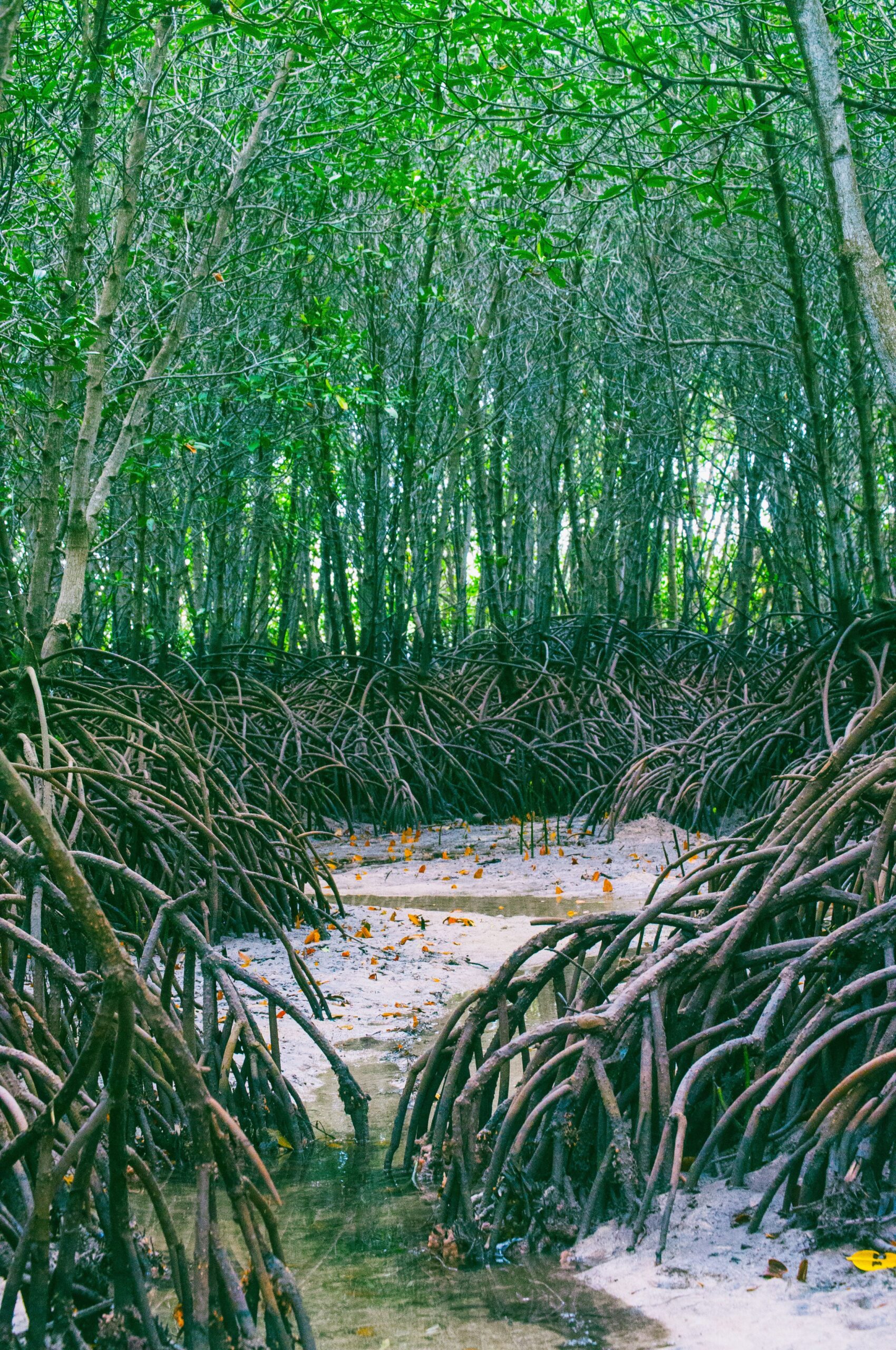
The World Bank Group defines blue carbon as the carbon dioxide stored in the world’s coastal and marine ecosystems, including mangroves, salt marshes, and seagrass beds. It is referred to as “blue” because of its connection to the ocean: carbon is sequestered primarily in coastal soils and sediments, up to six meters below the seafloor. What is remarkable is just how much these ecosystems do with so little space. According to research published in Nature Reviews Earth & Environment, blue carbon ecosystems cover less than 0.5% of the seafloor, yet they account for more than half of all the carbon stored in marine sediments.
The simplest way to understand the value of blue carbon is to compare it to a better-known form of carbon storage: a forest. The World Resources Institute points out that coastal blue carbon ecosystems store up to five times as much carbon per hectare than tropical forests and absorb carbon from the atmosphere about three times faster than tropical forests.
There are two reasons why blue carbon ecosystems are so effective. First, these plants grow fast. Juvenile red mangroves can grow up to one and a half meters in a single year. Rapid growth means they quickly absorb carbon dioxide. The second, and most unique, reason is that they grow in waterlogged soil that contains almost no no oxygen. In a terrestrial forest, when a tree dies, it decomposes and releases the carbon it had stored into the air. In a mangrove or seagrass bed, the oxygen-deprived soil significantly slows decomposition, so that carbon remains trapped in the sediments—often for hundreds or even thousands of years, according to the U.S. National Oceanic and Atmospheric Administration. The carbon is thus stored in the soil rather than in the plant, which explains why so little of it is released when a plant dies. In fact, in blue carbon ecosystems, between 60% and 90% of the carbon is retained in the soil; the opposite of a forest, where most of the carbon is found in the trees themselves.
Blue carbon ecosystems do much more than just store carbon. To translate their value into meaningful socioeconomic terms, they also protect communities from coastal erosion, ensure food security, and support local economies in ways that can be measured economically.
The Coastal Risk Index, developed by the Ocean Risk and Resilience Action Alliance (ORRAA), the University of California Santa Cruz, and IHE Delft, has revealed that mangroves protect 15 million people from flooding each year and reduce property damage caused by storms by more than USD$65 billion annually. In terms of food security, a 2023 study published in the Journal of Environmental Economics and Management found that fish catches can be up to 70% higher in waters near mangroves than in areas without them, which is of considerable importance to the small-scale fisheries on which coastal communities depend. Blue carbon ecosystems also drive sustainable tourism. In the Florida Keys National Marine Sanctuary alone, where mangroves and seagrass beds are the two dominant ecosystems, tourism related to the sanctuary contributes USD$4.4 billion annually to Florida’s economy and supports 43,000 jobs statewide.
Another notable finding is that, in the World Bank’s 2021 report Changing Wealth of Nations, between 1995 and 2018, the total area of mangroves decreased by about 4 %, and yet, over the same period, the value of mangroves for flood protection actually increased. The reason is worth considering: as coastal areas have developed, more people and higher-value assets have come to rely on the protection provided by mangroves. This means that each remaining mangrove area provided greater protection than before. The value of these ecosystems will continue to grow as the risks they protect against increase. The report’s authors expect that coastal development will drive this value through 2050, after which climate change itself will likely become the most significant risk factor.
Because these ecosystems store considerable amounts of carbon, the potential to translate this storage capacity into economic value continues to grow, supporting an emerging market for blue carbon finance. The carbon stored in mangroves, salt marshes, and seagrass beds has been estimated at up to USD$190 billion per year, according to Bertram et al. (2021), a figure roughly equivalent to the annual economic output of a country like New Zealand.
The most direct mechanism is the blue carbon credit, which monetizes the carbon stored in mangroves, salt marshes, and seagrass beds and reinvests the proceeds in their protection and restoration. A prime example is the project Mikoko Pamoja in Kenya, the first mangrove conservation initiative integrated into the voluntary carbon market, where revenue from carbon credits funds both ecosystem restoration and community development, including improved access to drinking water and educational infrastructure. However, despite growing interest, blue carbon remains a niche segment of the voluntary carbon market. As of March 2025, blue carbon projects accounted for only 0.03% of all credits issued through Verra, the world’s largest voluntary carbon registry.
Beyond individual projects, blue carbon is increasingly being integrated into broader sovereign and market-based financing frameworks. Blue bonds, a thematic subset of the green bond segment within the sustainable bond market, had reached USD$15.25 billion in global issuance by June 2025, according to a 2025 World Bank case study. This reflects the growing role of ocean-focused financial instruments within traditional capital markets. Within the broader system, blue bonds represent a modest but expanding instrument of sustainable finance, forming part of the global sustainable debt market, where annual issuances exceed USD$1 trillion.
In addition to bond markets, debt-for-nature swaps are also used to restructure sovereign debt in exchange for long-term environmental commitments, which are increasingly focused on the marine environment. In December 2022, Belize’s landmark debt-for-nature swap unlocked US$180 million for ocean conservation and established a national Blue Carbon Framework, illustrating how blue carbon fits into sovereign financing mechanisms.
In order to ensure the success of these new blue carbon finance mechanisms, methodologies to verify blue carbon projects have also emerged. At the project level, two complementary resources are available. The first is the High-Quality Blue Carbon Principles and Guidance (2022), developed by ORRAA, the Friends of Ocean Action at the World Economic Forum, Conservation International, and The Nature Conservancy, which sets the standard for what individual projects and credits should look like. It defines “high quality” at the individual credit level: land tenure security, credible carbon accounting, real benefits for both people and nature, and permanence. It also warns that selling carbon benefits without proper documentation, verification, or registry tracking is never compatible with high quality. The second resource is the High-Quality Blue Carbon Practitioners Guide (2024), led by Conservation International in collaboration with ORRAA and partners, translates these principles into on-the-ground practices, providing project developers with a common roadmap for meeting the standard.
To help project developers meet this standard, the enabling environment around them must also be in place. A key resource for guiding the creation of this enabling environment is the Blue Carbon Readiness Framework from the World Bank (2023), which operates at a level above that of individual projects. It is a step-by-step guide for governments, structured around three pillars: data and analysis (greenhouse gas inventories that enable proper accounting), policies and institutions (the rules and agencies that must be in place), and financing (the mobilization of public and private funds). Its goal is to help countries support blue carbon in a way that benefits both people and the climate, while meeting their commitments under the Paris Agreement.
Combining these two approaches is essential to ensuring the success of blue carbon financing. Where the Principles and the Practitioner’s Guide set the standard for credit and funding integrity, the Readiness Framework helps a country lay the necessary groundwork to achieve it. This groundwork only bears fruit when it produces the kind of high-quality credits and loans that the market can rely on.
Despite their immense value, these ecosystems have been destroyed at an alarming rate. According to a 2018 study conducted by Himes-Cornell et al., it is estimated that since the mid-twentieth century, 50% of the world’s salt marshes, 35% of its mangroves, and 29% of its seagrass beds have been degraded or lost. The United Nations Framework Convention on Climate Change (UNFCCC) has warned that if nothing changes, these ecosystems could disappear globally within a century. Two main pressures are the root causes: on one hand, rising sea levels and more intense storms; and on the other, coastal development for aquaculture, agriculture, and urban growth.
Destroying these ecosystems does more than just eliminate a carbon sink for the future; it releases carbon that was already sequestered. When mangroves are cleared to create shrimp ponds, the 2017 study by Kauffman et al. found that approximately 60% of the carbon originally stored was released into the atmosphere, proving that these protective systems can also become a source of emissions.
However, all is not lost. In June 2026, the Global Mangrove Alliance reported that the rate of mangrove loss has slowed considerably since 2000, and that much of the loss has been offset by new mangroves that are regenerating and expanding, particularly in river estuaries and along developing coastlines. Globally, mangroves have actually shown a net gain since around 2010. Many of the protected mangrove forests have become denser over time, offering signs of hope that the decline can be reversed.
Despite blue carbon’s potential to mitigate human carbon emissions, these ecosystems should not be viewed solely as a means of offsetting emissions elsewhere. The more the planet warms, the less reliable blue carbon may prove to be. It is a genuinely useful tool for carbon sequestration and storage, but it should not replace efforts to reduce and eliminate emissions.
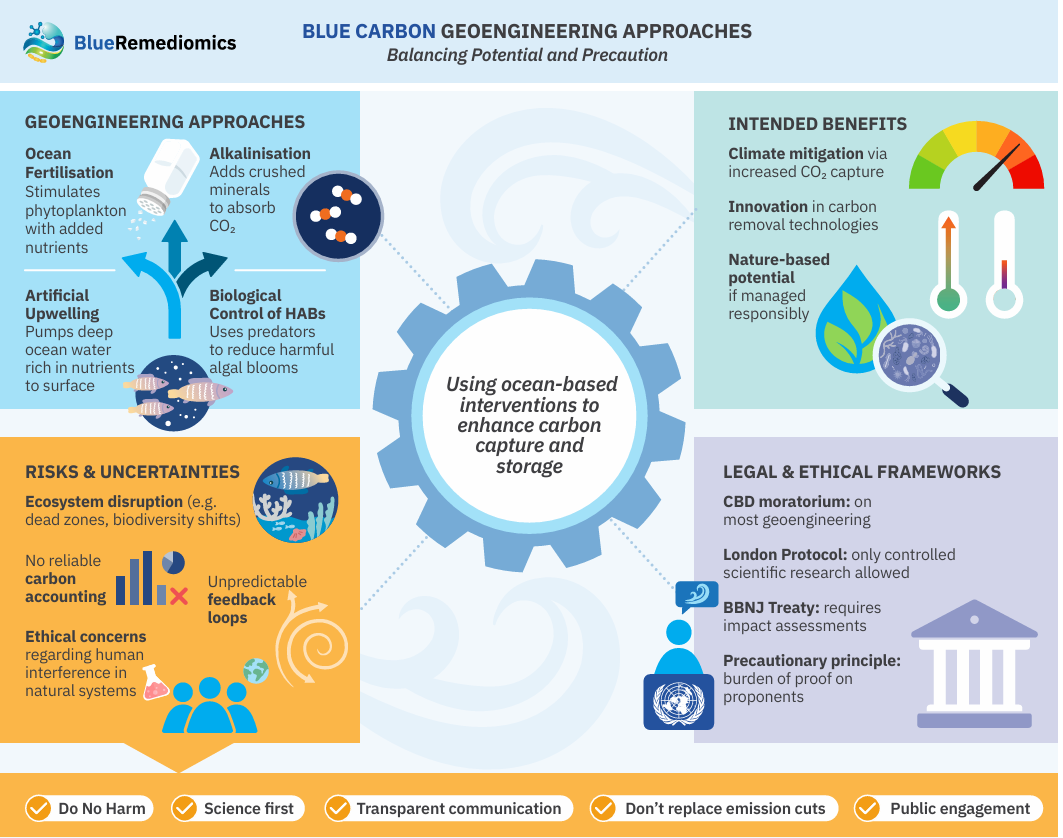
In addition, the term “blue carbon” also encompasses another set of related solutions: marine geoengineering. These are techniques that aim to enhance the ocean’s natural ability to absorb carbon through technical means such as adding iron to the water to trigger plankton blooms, adding crushed minerals to alter the water’s chemistry, or pumping nutrient-rich deep-ocean water to the surface, among other methods.
https://blueremediomics.eu/wp-content/uploads/2025/10/Blue-Carbon-Policy-Brief_WEB-VERSION.pdf
On paper, the potential looks promising. As reported by the Pulitzer Center, a modeling study found that adding one to two million metric tons of iron to the ocean each year could capture up to 45 billion metric tons of carbon by 2100. That’s roughly equivalent to one year’s worth of current global emissions, spread out over the rest of the century. These figures may seem significant, but they also come with a host of other problems.
First, there is no scientific consensus on the safety of these techniques. The Tara Ocean Foundation and many marine scientists emphasize the enormous uncertainty surrounding their effects, which could manifest over vast areas and long time scales.
Second, there is no reliable way to measure how much carbon is actually stored or for how long, which means there is no real way to verify that it works. The same modeling study that produced the promising figure also estimated that iron fertilization could reduce marine life by an additional 5%, partly by depriving other organisms of nutrients and by risking the creation of oxygen-depleted “dead zones.” And the real-world track record is thin: when entrepreneur Russ George dumped about 100 metric tons of iron off the coast of Canada in 2012, scientists found no evidence in the years that followed that it had any effect at all.
There is also an ethical dimension. Some of these technologies are already being sold on carbon markets despite lacking proven effectiveness, and experiments are often conducted in the waters of the Global South. The Global Forest Coalition has strongly criticized this trend of testing experimental technologies on communities least equipped to bear the consequences. However, the international rules governing marine geoengineering are clear. The Convention on Biological Diversity currently enforces a moratorium on most geoengineering operations affecting biodiversity; the London Protocol prohibits commercial ocean fertilization; and the 2023 Agreement on Marine Biodiversity in Areas Beyond National Jurisdiction (BBNJ) now requires environmental impact assessments for activities that may affect ocean life in international waters.
The contrast between natural blue carbon and artificial blue carbon is clear. With natural blue carbon, we know the storage figures with reasonable confidence. With geoengineering, the most basic question—how much carbon is actually captured and stored—remains unanswered. One is a living, measurable system that provides a long list of other benefits; the other is a gamble on mechanisms that no one can yet verify.
Natural blue carbon is exceptionally valuable. It stores carbon densely over hundreds to thousands of years, and provides ecosystem services such as protecting coastal communities, supporting food security, and sustaining local economies. These are benefits that tend to grow more valuable as climate change worsens. But that value holds only under two conditions. First, blue carbon works as a complement to cutting emissions, not as a substitute for it. And second, it depends on protecting real, existing ecosystems, with proper evidence. Unproven technological fixes sold as shortcuts to our Earth and Ocean’s natural process need to continue to be scrutinized at every level before entering the blue carbon equation. If treated honestly, blue carbon is a powerful climate ally. If treated as a quick fix, it's a distraction from the work that actually needs doing.