
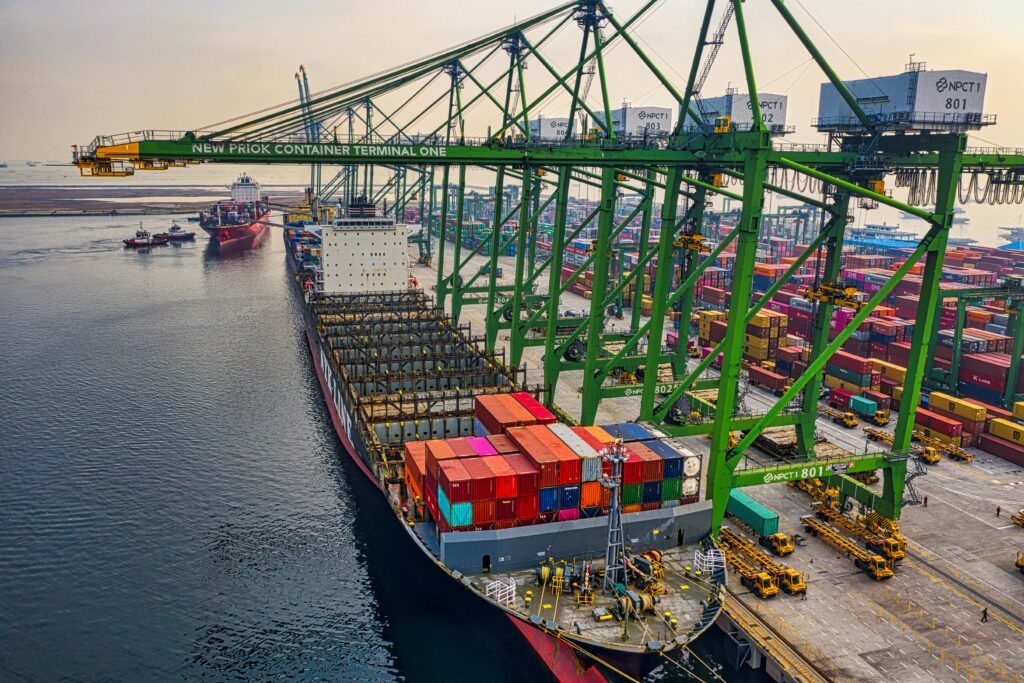
Regulatory developments are shaping an accelerated transition path. At the beginning of 2025, the European Union adopted a directive requiring large ports to install shore-side electrical outlets, enabling ships to switch off their engines during port calls and thus eliminating a major source of port pollution. Since 2024, shipping has also been integrated into the European carbon market: shipowners must now buy emission rights for their voyages in European waters, which automatically raises the cost of fossil fuels. On a global scale, the International Maritime Organization (IMO) revised its climate strategy in 2023 to aim for carbon neutrality in the sector by 2050, with binding intermediate milestones. Finally, the European FuelEU Maritime regulation, which came into force in January 2025, progressively requires the use of cleaner fuels in ships calling at EU ports. Together, these four texts form a regulatory framework that transforms previously optional investments into unavoidable compliance expenditure.
The most rapidly mobilizable innovations for the sector's transition are based on the intelligent exploitation of available data and artificial intelligence. Companies such as Nautilus Labs, Cetasol and Searoutes offer solutions that integrate real-time weather, ocean and traffic data to optimize routes, adjust ship speed and anticipate port constraints. Fuel consumption savings are estimated at between 3% and 15%, according to the International Maritime Organization (IMO) and the European Commission.
Optimization is based on the combination of several heterogeneous data streams in real time:
By combining these flows in artificial intelligence algorithms, the optimum route can be calculated not just in terms of distance or time, but simultaneously minimizing fuel consumption, emissions, weather risks and, increasingly, underwater noise in sensitive areas.
Waiting in port with engines running is a considerable and largely avoidable source of emissions. According to analyses by the World Bank and theUnited Nations Conference on Trade and Development (UNCTAD) , ships spend on average between 10 and 30% of their time waiting off the coast of ports, engines running to maintain course and position. Ship-port synchronization, via systems for communicating actual arrival times in advance and allocating mooring slots, makes it possible to switch to "just-in-time arrival" mode: the ship slows down at sea rather than arriving too early to wait in port. Startups such as Arinto (Berlin) offer software focused on optimizing arrival times, independently of routing.
The stakes are high: if all ships worldwide adopted this principle, fuel savings could amount to several tens of millions of tonnes of CO2 per year, according to the International Maritime Organization (IMO). The decisive advantage of these solutions is that they can be deployed rapidly, as they can be integrated into existing fleets without any major modifications to the vessel itself.
The return of wind-assisted propulsion is one of the industry's most spectacular innovations. Today, several technologies coexist at different stages of maturity.
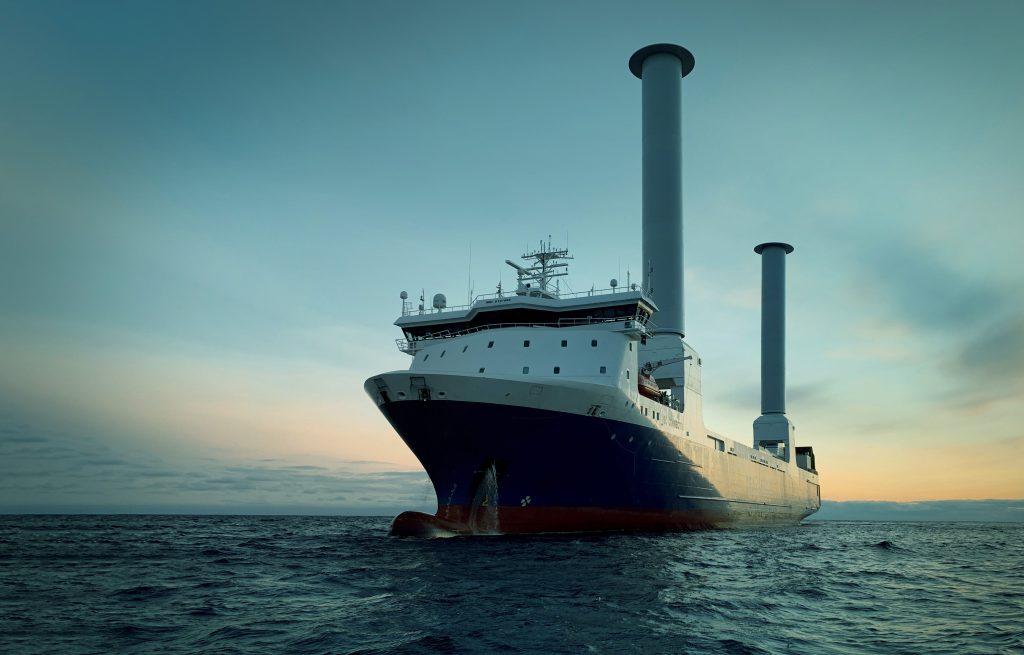
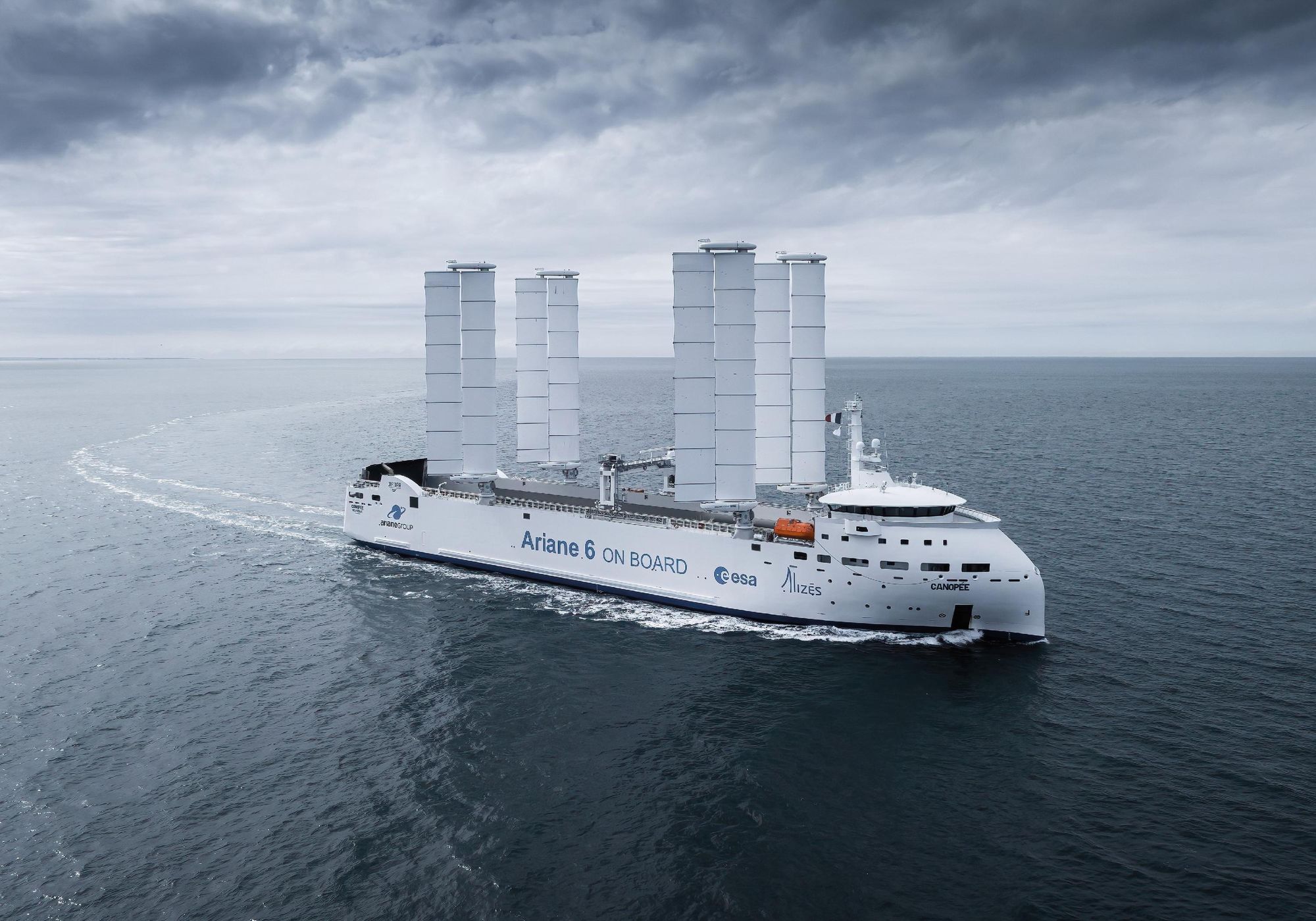
Flettner rotors, developed in particular by Norsepower, are vertical motorized cylinders that exploit the Magnus effect: when the wind blows perpendicular to their rotation, a lift force propels the vessel. These rotors can be retracted when not in use. Norsepower has equipped several commercial vessels (Maersk Pelican, Viking Grace, Canopée), with documented gains of 10 to 25% in fuel consumption, depending on conditions and route.
Rigid wings (or solid sails), developed by OceanWings (an AYRO subsidiary) or WindWings (BAR Technologies for Cargill), are vertical aerodynamic structures similar to vertically oriented aircraft wings. More efficient than flexible sails with equivalent surface area, they automatically adapt to wind angle. In 2024, the bulk carrier Pyxis Ocean sailed with four WindWings on its transatlantic crossing, demonstrating fuel savings of 14% on average and up to 30% in favorable conditions.
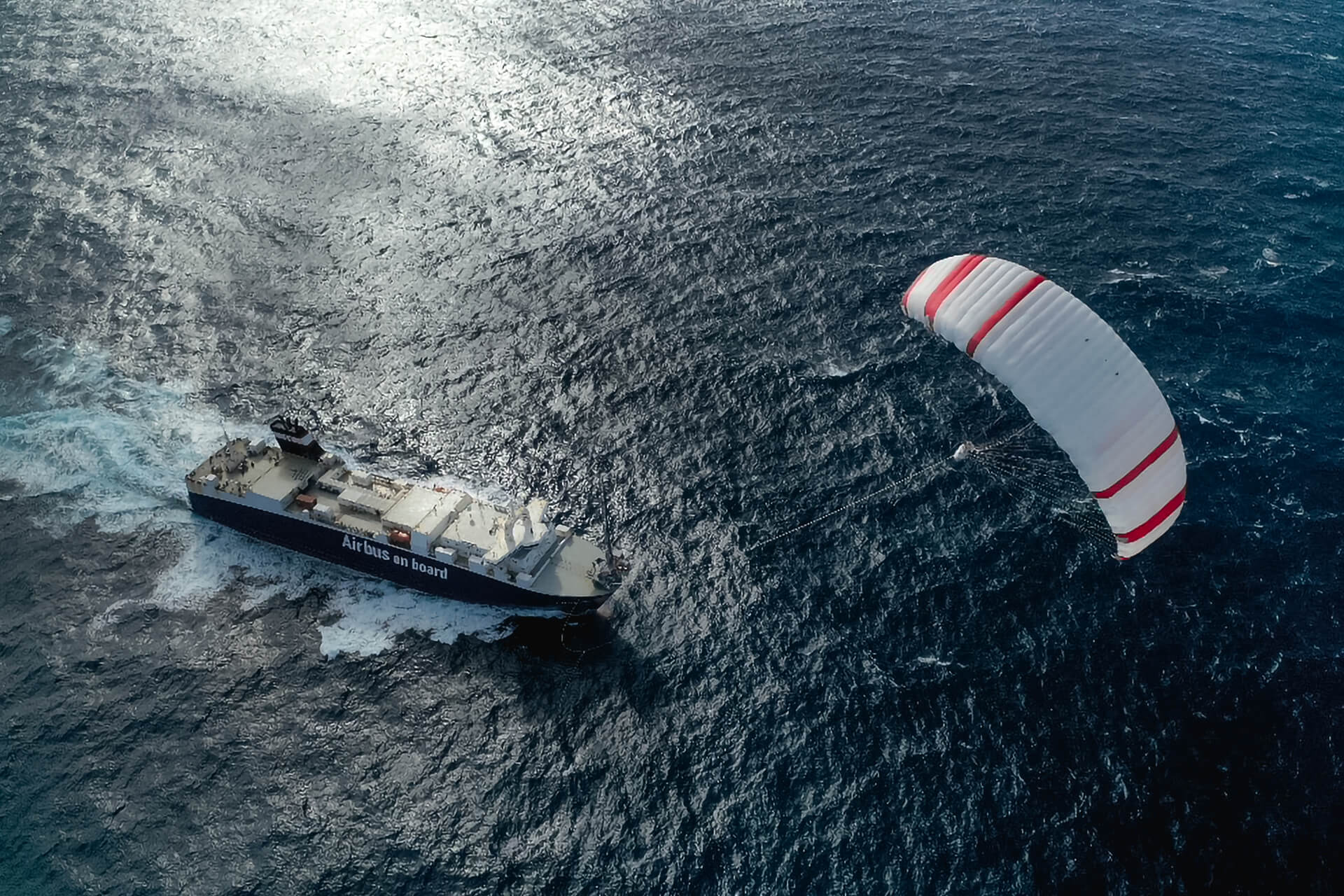
Kite s ails, developed by Airseas (an Airbus subsidiary), tow ships from the bow at high altitudes (200 to 300 meters), where winds are more stable and powerful. These systems are particularly well suited to transatlantic routes.
According to DNV (Det Norske Veritas), vee propulsion can reduce fuel consumption by 10-30% depending on operating conditions and route, making these solutions one of the most profitable levers in the short term, without any major technological breakthroughs.
Methanol, ammonia and hydrogen have been identified by the International Energy Agency (IAEA) as key solutions for achieving long-term climate goals. Maersk has invested heavily in green methanol ships and has put several into service since 2023. However, these fuels face major obstacles.
In terms of availability and infrastructure, world production of green methanol or green ammonia is currently tiny (6.4 million tonnes according to PortNews) compared with the 300 million tonnes of fuel needed annually (Global Maritime Forum). Bunkering facilities in ports are virtually non-existent for these fuels. Ammonia, in particular, is highly toxic and corrosive, posing major safety challenges for crews.
Liquefied natural gas (LNG), long touted as a transitional fuel, is seeing its climate benefits called into question. According to the International Council on Clean Transportation, LNG engines release unburned methane (methane slip), a gas with a very high global warming potential, which could make the climatic impact of LNG equivalent or even worse than that of heavy fuel oil over 20 years.
The risk of lock-in is also real: ships built today with LNG engines have a lifespan of 25 to 30 years, during which they will be dependent on a fossil fuel infrastructure that is hardly compatible with 2050 climate targets.
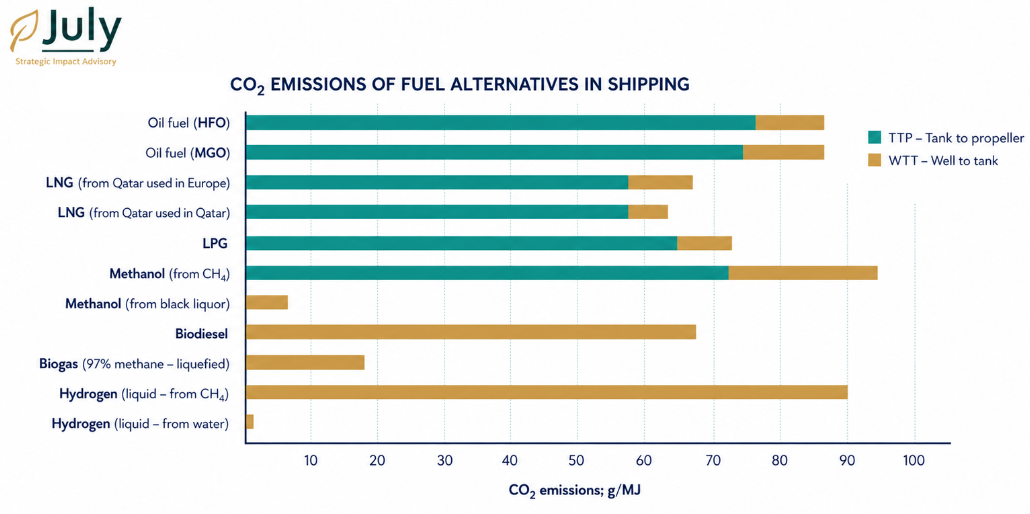
Source: DNV GL Releases Review of Marine Fuel Alternatives
This chart distinguishes between two types of emissions:
It should be stressed that the climatic benefits of each fuel depend as much on its production as on its on-board use. Hydrogen is the clearest illustration of this: produced from fossil gas, its emissions are very high over the entire life cycle; produced with renewable electricity, they are virtually zero. The same logic applies to methanol and ammonia.
Advances in hydrodynamic hull design, the use of new-generation antifouling paints to reduce water resistance, optimized bow bulbs that modify the waves created by the hull to reduce drag, and on-board energy recovery systems (engine heat recovery, integrated solar panels) are making it possible to achieve energy efficiency gains of up to 20-30%. These improvements represent a fundamental lever, as they apply to every ship over its entire lifespan.
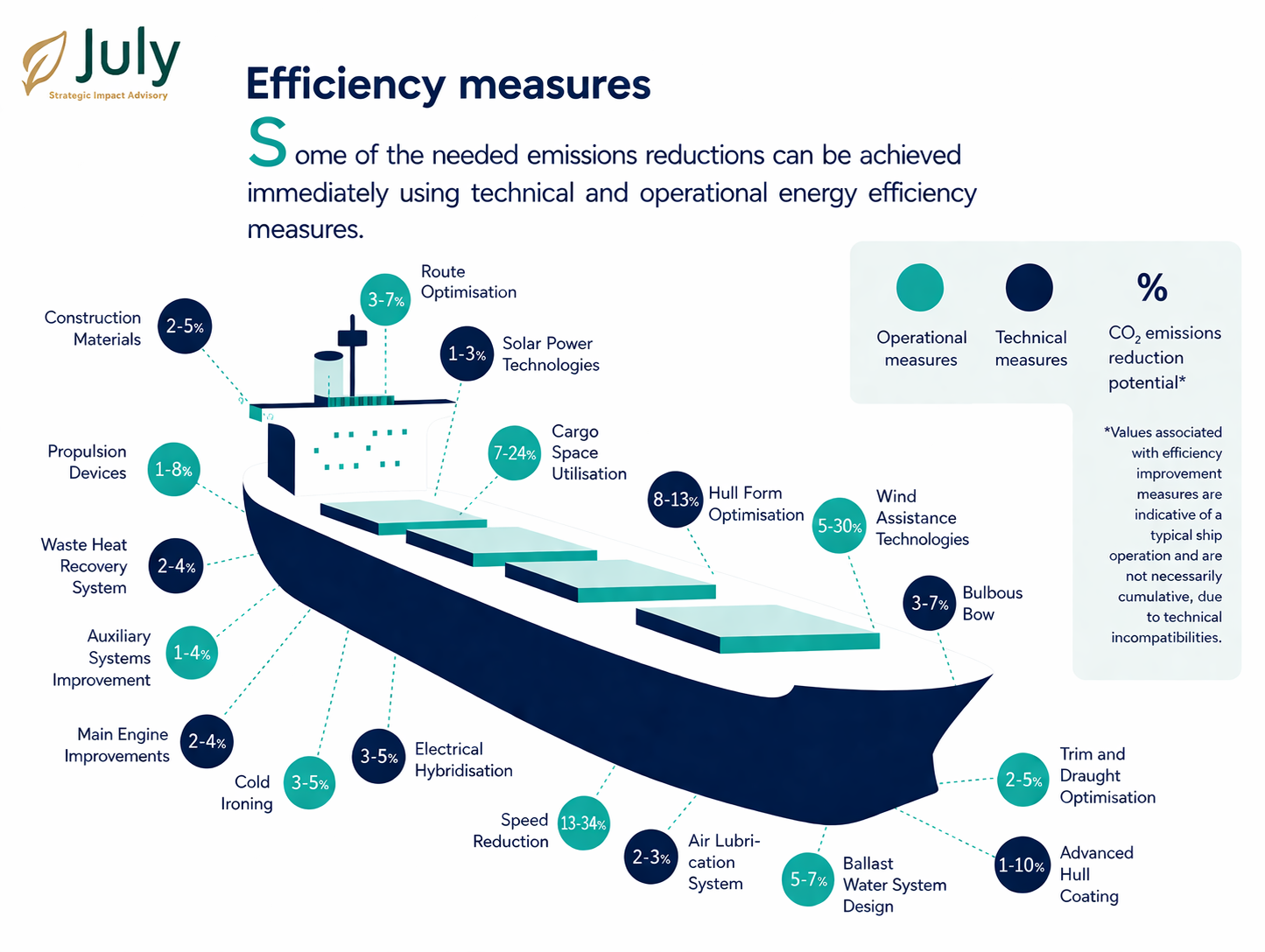
Source : Safety4sea
Intelligent containers (IoT) enabling real-time tracking (temperature, shocks, location), AI-based load optimization and the pooling of logistics flows are undeniably improving the systemic efficiency of maritime transport. Fewer empty runs, better fill rates, fewer losses: the indirect environmental gains are real.
However, we need to be clear about one important limitation: more efficient and less costly logistics can also have a rebound effect, by making sea transport cheaper overall, and thus encouraging greater volumes to be transported. Technological efficiency alone is not enough if it is not accompanied by sobriety policies and an increase in the carbon cost of transport. Automation and intelligent containers are optimization tools, not absolute flow reduction tools. True sobriety implies questioning the necessity of the flows themselves, which digitalization alone does not do.
A new generation of innovations aims to integrate much broader environmental parameters than meteorology alone into ships' operational decisions.
Companies like Amphitrite are developing platforms that combine ocean data (currents, waves, thermoclines), climate data (storms, ice zones, rising temperatures) and fleet operational data in real time, to enable both economic and environmental risk management. GT Green Technologies and Smart Green Shipping integrate underwater noise and emissions data into route optimization, helping to avoid critical areas for certain cetacean species.
The data infrastructures on which these innovations are based are varied: Copernicus Marine Service (CMEMS) provides operational oceanographic data on a global scale, including temperature, salinity, currents, sea level and chlorophyll concentrations. OBIS aggregates millions of marine species occurrences, enabling the mapping of sensitive areas and migratory corridors. NOAA's long time series complement these sources. The worldwide AIS system, combined with surveillance satellites, enables us to cross-reference ship positions with ecologically sensitive areas.
Concrete projects illustrate this convergence. The World Economic Forum's Green Shipping Corridors Initiative, which brings together 40 ports and operators worldwide, aims to create shipping corridors with reduced emissions on the busiest routes. Amphitrite's Oceanscan project combines routing and avoidance of cetacean spawning grounds on the transatlantic route. These projects show that shipping can evolve from a purely economic logic to a multi-objective one, in which the impact on ecosystems becomes an operational parameter in its own right.
All these innovations are part of a rapidly evolving investment ecosystem. Over the past decade, ocean and marine technology startups have raised over $5 billion in venture capital in the United States, according to J.P. Morgan. Dedicated funds are emerging: theDOCK, Flagship Founders, Signal Ventures, Future Planet Capital and TecPier, Innoport and InMotion Ventures.
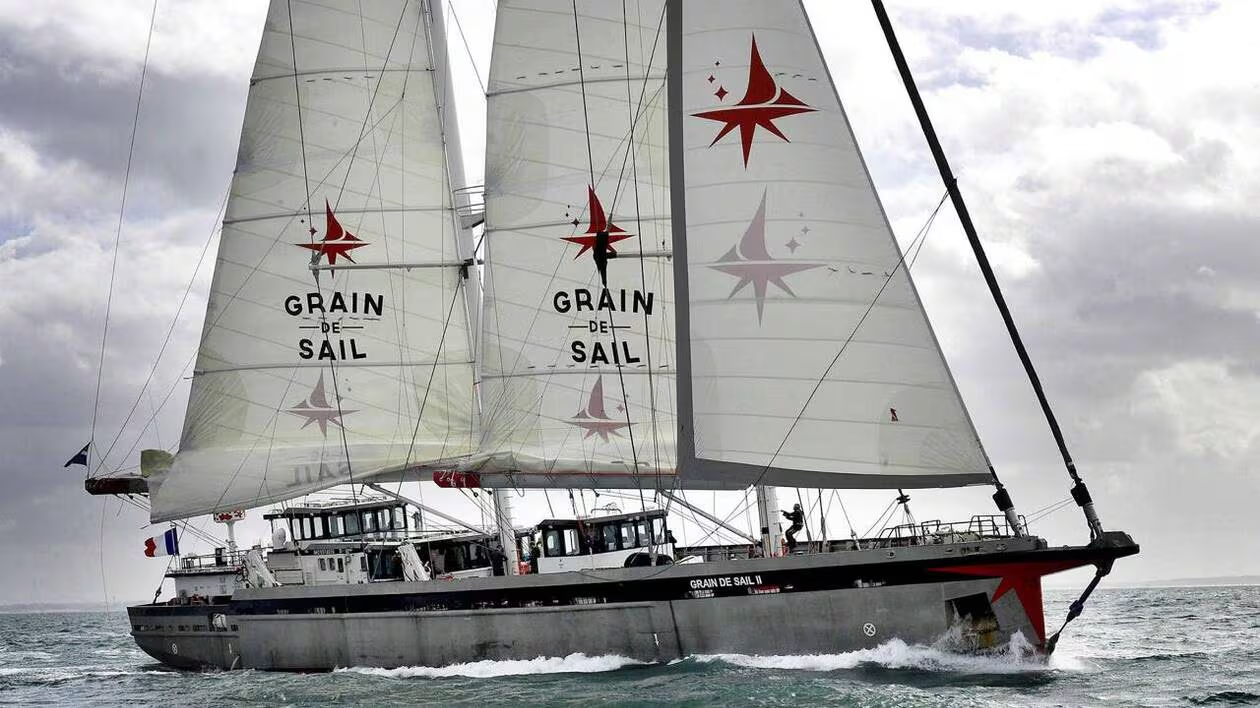
A French example illustrates how this mobilization can also come from the consumer. Grain de Sail, a company based in Morlaix, Brittany, combines sailing and short food supply chains: it imports cocoa, coffee and rum from the Caribbean on its pure-vehicle cargo ships, then exports chocolate and wine to the USA on the return journey. Its second vessel, Grain de Sail II (52 meters, 350 tons capacity), entered service in early 2024 on the Saint-Malo-New York route. The company has just finalized a fund-raising operation with the support of Bpifrance to finance Grain de Sail III: a 110-meter sail container ship, capable of carrying 200 containers or 3,000 tons, scheduled to enter service in mid-2028 at a cost of 35 million euros.
On the international finance side, the Poseidon Principles are the reference framework for aligning bank financing decisions with climate objectives. Launched in 2019 under the aegis of the Global Maritime Forum, they now bring together 35 major financial institutions representing almost 80% of the global marine financing portfolio, including Société Générale, Citi, ING, Crédit Agricole CIB, BNP Paribas and KfW. Each signatory undertakes to measure the carbon intensity of its portfolio annually, to compare it with a trajectory aligned with IMO targets, and to make its alignment scores public. The 2025 annual report shows that signatories have declared 95% of their business eligible, and that climate alignment scores have improved by almost 8 percentage points on the previous year.
The central challenge of the next decade is not so much a question of technological feasibility as of the ability to massively redirect capital flows towards transition solutions. The gains made by existing technologies are real, but insufficient on their own to align shipping on a trajectory compatible with the Paris Agreement's 2°C target, in the absence of a major breakthrough in low-carbon fuels. The challenge therefore lies less in a miracle solution than in building an economic model in which alternatives to fossil fuels gradually become more competitive: a sufficiently attractive carbon price, blended finance mechanisms to absorb the risk of emerging technologies, and green corridors capable of structuring large-scale demand.