
In 2022, Emmanuel Macron used the word in a speech to the government, associating the political moment with a 'grand bascule' marked by the end of 'abundance, obviousness and insouciance'. The speech was criticized on the left and by some trade unions for sending out the wrong message: "for many French people, the sacrifices have already been made", declared CGT General Secretary Philippe Martinez. The paradox is striking: the richest 1% emit as much CO2 as two-thirds of humanity. The sobriety demanded is rarely that of the highest emitters. This stance was in line with a certain left-wing political discourse linked to ecology and the degrowth movement, which calls for a rethink of our lifestyles and the adoption of sobriety. And the figures give reason for concern: since 1970, the use of natural resources worldwide has quadrupled. According to the OECD, it is set to double again by 2060.
And yet, this discourse is hard to convince. Clément Sénéchal showed in an essay in 2024 - Pourquoi l'écologie toujours perd? - how the environmental discourse of the elites remains inaudible to a large part of the population. He criticizes an ecology of spectacle, disconnected from social realities, using as a symbol the image of Brigitte Bardot landing on the ice floes at the end of the 1970s to oppose seal hunting, without considering that it was the livelihood of fishing families that she was condemning in front of the world's cameras.
A year later, Ezra Klein and Derek Thompson finally published the answer to Clément Sénéchal's question, or rather the alternative to this statement of failure. Their book begins - and for this point alone it is salutary - with an account of what the year 2050 might look like. Entitled 'Beyond scarcity', this incipit begins as follows: "You open your eyes at dawn and turn over in fresh sheets. A few meters above your head, fixed to the top of the roof, a layer of solar panels glistens in the morning sun.' Then continues the description of a new world where renewable energies are everywhere, where we eat local and seasonal produce, where the air is clean and cities are finally silent. It's also a world where technology has the upper hand: meat is produced in laboratories thanks to abundant electricity, deliveries are made exclusively by drones, leisure time is more important thanks to the productivity gains of AI, we continue to fly thanks to new fuels and the New York-London journey takes just two hours.
Starting with the ends rather than the means is rare enough to merit a mention. This is surely one of the reasons for the success of this book, which in other respects seems a little short-sighted in its arguments, notably ignoring the subject of resource limits (interviewed on this subject by Le Monde a few days ago, Ezra Klein is very quick to say: 'There are planetary limits, of course, but they haven't yet been reached'). The authors do acknowledge the limits of fossil fuels, but dodge the question of resources in the broadest sense. They do, however, quote Jason Hickel, who imagines what we would do if nuclear fusion became a reality: "Exactly what we do with fossil fuels: cut down more forests, fish more, dig up more mountains, build more roads, expand industrial agriculture, pile up more waste". Abundant energy has never curbed consumption; it has accelerated it.
Their response is pragmatic: rather than unpopular taxes - in 2022, 90 countries saw protests against rising petrol prices, and it's often these same populations who then turn to the far right - they prefer to make alternatives desirable and accessible. Fair enough. But in doing so, they ignore the material impact of the transition itself, which Philippe Bihouix and Guillaume Pitron have documented: manufacturing a solar panel requires silicon, an offshore wind turbine nearly a ton of neodymium, and a car battery cobalt, lithium and graphite - materials whose recycling remains very partial. A low-carbon world will not be a low-resource world. Clean technologies require dirty metals. Between 2015 and 2050, humanity will consume as much metal as it has extracted since the beginning of history.
While the authors seem to have little interest in the practical conditions of this material extension, they do make some important observations about land use, pointing out that 50% of habitable land is used for agriculture, three-quarters of which is used for livestock production alone. Logically, they advocate a local diet with much less meat. But the book stops there. Not a word about textiles, technological goods, gadgets - all this disposable production flow that nevertheless weighs heavily in the material footprint of wealthy societies. Not a word either about the planetary limits that have already been crossed: chemical pollution and the proliferation of new entities (plastics, endocrine disruptors, nanoparticles), which constitute one of the nine limits identified by the Stockholm Resilience Center, and precisely the one whose overstepping is most advanced today.
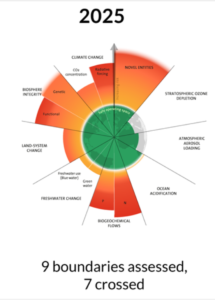
Planetary boundaries - Stockholm Resilience Centre
This in no way detracts from their real contributions. One of the most stimulating is what they call the myth of the genius inventor: the idea that progress is the fruit of individual flashes of genius. History remembers Fleming discovering penicillin in 1928, but forgets what made it possible. When Howard Florey and Ernst Chain tested it on humans at the start of the war, the results were still fragile. It was the mobilization of American industry that turned the tide: the OSRD (Office of Scientific Research and Development) created in 1941, then the War Production Board, transformed a promising scientific project into a mass-market drug. From 10 million doses per plant per month in 1942, the number rose to nearly 700 million by 1945, with production costs cut twenty-fold. It was not the invention alone that saved millions of lives, but the public will to deploy it.
The same pattern can be seen in solar energy: invented in the USA in the 1950s, industrialized by Germany in the 1990s, then made accessible by China in the 2000s. Beijing, deprived of sufficient fossil resources to power an economy of one billion inhabitants, made a massive strategic choice: subsidies, subsidized loans, free land for panel manufacturers. In the United States, on the other hand, policies have been up and down, and the Inflation Reduction Act, which had boosted the sector under President Biden, was called into question by the 'One Big Beautiful Bill' of July 2025, which ended subsidies for solar power from 2027.
The success of an innovation thus depends much more on implementation than on the technological discovery itself, on the collective rather than the individual, however brilliant.
But we need innovation, and this is where the essay touches on something deeper. In 1982, in The Rise and Decline of Nations, Mancur Olson observed a counter-intuitive paradox: nations that stagnate are often those that have experienced a long period of stability, whereas post-war Germany and Japan, starting from almost nothing, have experienced decades of lightning catch-up. A society installed in abundance ends up rewarding those who know how to navigate its rules rather than those who drive it forward: fewer engineers, more lawyers and consultants.
Yet the world remains full of unsolved problems: clean kerosene, decarbonized cement, removing CO2 from the atmosphere. Cellular ageing remains a mystery, and Alzheimer's remains untreated. Innovation is not behind us, it is simply misdirected or insufficiently supported.
While Klein and Thompson defend an abundance focused on housing construction and clean energies, they leave untouched the blind spots already mentioned: disposable consumption, fast fashion, mobility that we seek to decarbonize without ever questioning its uses. However, their strength lies elsewhere: they pose a truth that too many environmentalists refuse to admit. As long as we don't propose a future that makes us want to live in, ecology will never take hold. Imposed sobriety always loses.
Back to the land of Cocagne. Back in the 1960s, my grandfather wrote that the two cataclysms of the modern world were television and the private car (I can't imagine what he would have thought of smartphones and social networking). He saw in these inventions, which for many embodied the beginning of abundance and prosperity, the advent of a society turned in on itself, isolating itself where it could find itself. This speech was written to convince the inhabitants of the commune of which he was mayor to build a sports hall so that they could play basketball and theater, and develop the sporting and cultural activities of the Réveil de Saint-Sornin, the association he had helped to create in the aftermath of the Second World War.

Le Réveil still exists. It celebrated its 80th anniversary last year and now has around ten sections and 500 members for a town of 800 inhabitants. The sports hall has been built, and has borne his name for several years. His vegetable garden, on the other hand, no longer exists. It has reverted to wasteland. What will be done with this land? Raspberries and roses, or pavilions with black window frames and gravel concrete paths? It's up to us to choose the abundance we want, and for the public authorities to support these choices: by supporting the renovation of old buildings rather than encouraging urban sprawl, by valuing the land as something other than a simple building site, by training people in agricultural and manual trades. The abundance we want is not just made up of material things, but of knowledge, links and creation - luxury, calm and pleasure.